| [Index] |
| William Alfred COTTEE (1833 - 1904) |
| bank manager |
| Children | Self + Spouses | Parents | Grandparents | Greatgrandparents |
| William Alfred COTTEE (1833 - 1904) | William COTTEE (1807 - 1860) | Benjamin COTTEE (1768 - 1842) | ||
| Rebecca BOUTWOOD (1769 - 1842) | ||||
| Elizabeth Munnings POTTO (1810 - 1854) | ||||
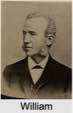
|
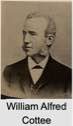
|
| b. 1833 at Maldon, Essex, England |
| d. 1904 at Strathfield, New South Wales, Australia aged 71 |
| Near Relatives of William Alfred COTTEE (1833 - 1904) | ||||||
| Relationship | Person | Born | Birth Place | Died | Death Place | Age |
| Grandfather | Benjamin COTTEE | 1768 | Witham, Essex, England | 1842 | Maldon, Essex, England | 74 |
| Grandmother | Rebecca BOUTWOOD | 1769 | 1842 | 73 | ||
| Father | William COTTEE | 1807 | Witham, Essex, England | 1860 | Maldon, Essex, England | 53 |
| Mother | Elizabeth Munnings POTTO | 1810 | 1854 | 44 | ||
| Self | William Alfred COTTEE | 1833 | Maldon, Essex, England | 1904 | Strathfield, New South Wales, Australia | 71 |
| Uncle | James COTTEE | 1804 | Witham, Essex, England | 1861 | Ballarat, Victoria, Australia | 57 |
| Aunt | Elizabeth CARTER | 1808 | 1869 | 61 | ||
| Cousin | Spencer COTTEE | 1833 | Witham, Essex, England | 1878 | Richmond River, New South Wales, Australia | 45 |
| Events in William Alfred COTTEE (1833 - 1904)'s life | |||||
| Date | Age | Event | Place | Notes | Src |
| 1833 | William Alfred COTTEE was born | Maldon, Essex, England | |||
| 1854 | 21 | Death of mother Elizabeth Munnings POTTO (aged 44) | |||
| 1860 | 27 | Death of father William COTTEE (aged 53) | Maldon, Essex, England | ||
| 1904 | 71 | William Alfred COTTEE died | Strathfield, New South Wales, Australia | ||
| Personal Notes: |
|
Australian Dictionary of Biography
https://adb.anu.edu.au/biography/cottee-william-alfred-3268 William Alfred Cottee (1833–1904) by John Eddis Linton William Alfred Cottee (1833-1904), banker, pastoral company manager and financial adviser, was born at Maldon, Essex, England, son of William Cottee (d.1855), merchant, and his wife Elizabeth, née Potto, who predeceased her husband. He was employed by Leaf Sons & Co. of London who gave him a testimonial on his resignation in 1858 to emigrate to New South Wales. At Stoke by Nayland, Suffolk, he married Susannah Munnings of Little Horkesley Hall, Essex, and sailed with her in the Lochiel; they arrived at Sydney on 30 November. He took up residence at Parramatta and applied for a clerical position with the Australian Joint Stock Bank. He was appointed to the Sydney office on 24 December: his official security was provided at £500 each by Dr Richard Greenup and by Renwick & Bate, drapers of Sydney. Cottee's rise in the service of the bank was rapid. From a clerk at £150 a year he was promoted teller at Bathurst in 1859, manager of a new branch at Yass in 1860 and next year relieving manager at Wagga Wagga, the chief branch. When the manager, Cornelius Hinchey, resigned Cottee was confirmed in October 1861 as Wagga branch manager at a salary of £400. In the next fifteen years he won repute for his competence and for shrewd administration of the bank's financial policy; on 27 January 1874, towards the end of his career with the bank, the board 'voted a bonus of £100 allowed on account of … the freedom from bad debts by which his Management has been distinguished'. He was also widely recognized as an expert in the complex State Land Acts and became friend and adviser to many graziers in the Riverina, such as the brothers Byron and Robert Bruce Ronald and James MacBain. They had properties in the Riverina and were partners in Gibbs, Ronald & Co., a stock and station agency based on Geelong, whose main activity was the consignment of wool to London for sale on commission. In 1863 the Australian Mortgage Land and Finance Co. Ltd was promoted in England by Sir Charles Nicholson, with the active support of Sir Henry Edward Fox Young, David Aitcheson, Henry Jordan and others, all confident of investment possibilities in Australia. By 1865 this company had realized that the financial tide in Queensland had turned against urban land investment in Brisbane so, in order to break into the pastoral industry, the business of Gibbs, Ronald & Co. was acquired, with Richard Gibbs and Byron Ronald, Cottee's friend, joining the London board. When Gibbs became chairman of A.M.L. & F. in 1875 it was decided to open an office in Sydney, for progress of the railway into the Riverina meant that cheaper freight would divert much of the existing wool business from Melbourne to Sydney. Since the retention of this business was essential Cottee was a logical choice for the management: he knew the Riverina intimately; he was a close friend of the Australian general manager, Edmund Young; he had acted as banker and adviser in land matters to the chairman and a director of the board. The bank accepted his resignation with regret and Cottee opened the Sydney office of A.M.L. & F. in 1876. With Cottee's expert knowledge and experience the new branch prospered. Although the lending policy was conservative his decisions had widespread influence and he attracted the business of many leading graziers, thus strengthening his company's place in the pastoral world. Cottee brought his wife and six children to Sydney and built a home, Felixtowe, at Strathfield. He also became active in civic affairs, serving on the council of the Chamber of Commerce in 1880-87 and founding its library. He realized the potential of Thomas Mort's efforts to establish the export of frozen meat and actively supported the trade after the first successful shipment in the Strathleven in 1880. From 1881 Cottee arranged the killing, mainly at Orange, and export of frozen mutton in bags marked with the A.M.L. & F. brand; the first shipment of 1825 lambs went to London in the Catania in August. Cottee foresaw as early as 1876 that local wool selling and wool stores would become essential, but his own company did not adopt them until 1907. He campaigned for improvements in the methods of shipping wool and was successful in having single dumping adopted. After twenty-one years as manager he retired in 1897, joining the local board of advice of A.M.L. & F. and the board of the Bank of New South Wales on which he served until his death on 15 March 1904, aged 70. James Kidd, who succeeded him as manager, paid this tribute: 'We have few such characters in our community and they can ill be spared'. He was survived by his widow, three married daughters and three sons: Edgar Alfred, manager of the Commercial Bank at Mittagong; Herbert William, farmer of Wallendbeen; Dr Arthur Ivan, dentist of Sydney. |
| Source References: |
| 90. Type: Book, Abbr: History of Wagga, Title: A History of Wagga Wagga, Auth: Keith Swan, Date: 1970 |
| - Reference = facing p 40, p102-3, 112-3 (Name, Notes) |
| - Notes: p102-3 William Alfred Cottee (1833-1904) was born at Maldon, Essex, England and had a brief business career before migrating to New South Wales in 1858. Immediately on arrival he accepted a position with the Australian Joint Stock Bank in whose service he rose rapidly. He began as a clerk in the Sydney office and was then promoted to teller at Bathurst in 1859, to manager at Yass in 1860 and to manager at Wagga Wagga, the bank's chief branch, in October 1861 after spending some time there as relieving manager. He remained in Wagga Wagga until he resigned in 1876 to become Sydney manager of the Australian Mortgage Land and Finance Co. Ltd, a position he held until he retired in 1897. From 1897 until his death in 1904 Cottee was a member of the local Board of Advice of the A.M.L. & F. Co. Ltd, and of the Board of the Bank of New South Wales.
W. A. Cottee owed his success after 1876 partly to the experience and reputation he established in Wagga Wagga. The Board of the Australian Joint Stock Bank, for example, voted him a bonus of £100 in 1874 'on account of ... the freedom from bad debts by which his Management has been distinguished' 36 The local newspapers recorded his participation on the committees of the Church of England, the Mechanics' Institute, the Murrumbidgee Pastoral Association and the Hospital-the list is by no means exhaustive and clearly proved his leadership, for he was frequently asked to chair meetings and his advice was eagerly sought. For that matter, graziers still sought his advice when he transferred to Sydney.87 Before he left Wagga Wagga Cottee was given a testimonial of £508 13s,8 which was evidence both of his high reputation and of the prosperity of the community. p112-3 All of this development caused the town to expand and its citizens to erect more permanent buildings, usually of brick. At his farewell in 1876 W. Á. Cottee said When I first came to Wagga, some fifteen years ago, the business of the Australian Joint Stock Bank was carried on in an old slab building, covered with bark. After some time I succeeded in inducing the landlord to cover it with shingles to make it more secure... Gurwood Street... [was] then filled with stumps... and below the Commercial [Romano's hotel] there was a lagoon with black swans swimming about. |