| [Index] |
| Hamilton HUME (1797 - 1873) |
| Explorer, grazier, magistrate |
| Children | Self + Spouses | Parents | Grandparents | Greatgrandparents |
| Hamilton HUME (1797 - 1873) + Elizabeth DIGHT (1802 - 1886) |
Andrew Hamilton HUME (1762 - 1849) | |||
| Elizabeth Moore KENNEDY (1760 - 1847) | John KENNEDY (1737 - 1819) | |||
| Mary GASCOPODI | ||||
|
|
| b. 19 Jun 1797 at Parramatta, New South Wales, Australia |
| m. 08 Nov 1825 Elizabeth DIGHT (1802 - 1886) at Sydney, New South Wales, Australia |
| d. 19 Apr 1873 at Yass, New South Wales, Australia aged 75 |
| Near Relatives of Hamilton HUME (1797 - 1873) | ||||||
| Relationship | Person | Born | Birth Place | Died | Death Place | Age |
| Grandfather | John KENNEDY | 1737 | 1819 | 82 | ||
| Grandmother | Mary GASCOPODI | |||||
| Father in Law | John DIGHT | |||||
| Mother in Law | Hannah HILTON | |||||
| Father | Andrew Hamilton HUME | abt 1762 | 23 Sep 1849 | Marulen, New South Wales, Australia | 87 | |
| Mother | Elizabeth Moore KENNEDY | abt 1760 | 14 Aug 1847 | Gunning, New South Wales, Australia | 87 | |
| Self | Hamilton HUME | 19 Jun 1797 | Parramatta, New South Wales, Australia | 19 Apr 1873 | Yass, New South Wales, Australia | 75 |
| Wife | Elizabeth DIGHT | 22 Sep 1802 | Sydney, New South Wales, Australia | 1886 | 84 | |
| Sister | Isabella HUME | 13 Dec 1798 | Toongabbie, New South Wales, Australia | 05 Aug 1855 | Marulen, New South Wales, Australia | 56 |
| Brother | John Kennedy HUME | 1800 | Toongabbie, New South Wales, Australia | 20 Jan 1840 | Gunning, New South Wales, Australia | 40 |
| Brother | Francis Rawdon HUME | 13 Nov 1803 | Toongabbie, New South Wales, Australia | |||
| Uncle | James Raworth KENNEDY | abt 1757 | Teston, Kent, England | 1826 | Windsor, New South Wales, Australia | 69 |
| Aunt | Elizabeth (Lydia) PEARCE | 1760 | 1794 | England | 34 | |
| Cousin | John KENNEDY | 1780 | 1843 | New South Wales, Australia | 63 | |
| Cousin | Elizabeth Charlotte KENNEDY | 1783 | Nettlestead, Kent England | 20 Dec 1843 | Wollongong, New South Wales, Australia | 60 |
| Cousin | Jane KENNEDY | 1785 | 1859 | Australia | 74 | |
| Cousin | Louisa Sophia KENNEDY | 1790 | 1837 | Australia | 47 | |
| Niece | Harriotte Eliza Kennedy HUME | |||||
| Niece | Eliza HUME | 1824 | ||||
| Nephew | Henry John SHARP | 01 Sep 1843 | Sharp's Creek, New South Wales, Australia | 25 Sep 1903 | Adelong, New South Wales, Australia | 60 |
| Niece | Lucy Sophia SHARP | 11 Aug 1845 | Adelong, New South Wales, Australia | 21 Feb 1930 | Darling Point, New South Wales, Australia | 84 |
| Niece | Fanny Elizabeth SHARP | 28 Nov 1847 | Yass, New South Wales, Australia | 1908 | 61 | |
| Niece | Emily Jane SHARP | 08 Jan 1850 | Yass, New South Wales, Australia | 09 Nov 1928 | 78 | |
| Nephew | Arthur SHARP | 1853 | Tumut, New South Wales, Australia | 1915 | 62 | |
| Niece | Mary SHARP | 1855 | Yass, New South Wales, Australia | 1927 | 72 | |
| Niece | Eleanor Susan SHARP | 1862 | Tumut, New South Wales, Australia | 1920 | 58 | |
| Sister in Law | Jane DIGHT | 15 Dec 1817 | Richmond, New South Wales, Australia | 13 Apr 1899 | Yass, New South Wales, Australia | 81 |
| Sister in Law | Harriotte Georgina MALTHEY | |||||
| Sister in Law | Elizabeth O'NEILL | |||||
| Sister in Law | Emma MITCHELL | abt 1814 | ||||
| Events in Hamilton HUME (1797 - 1873)'s life | |||||
| Date | Age | Event | Place | Notes | Src |
| 19 Jun 1797 | Hamilton HUME was born | Parramatta, New South Wales, Australia | 18 | ||
| 08 Nov 1825 | 28 | Married Elizabeth DIGHT (aged 23) | Sydney, New South Wales, Australia | ||
| 14 Aug 1847 | 50 | Death of mother Elizabeth Moore KENNEDY (aged 87) | Gunning, New South Wales, Australia | 18 | |
| 23 Sep 1849 | 52 | Death of father Andrew Hamilton HUME (aged 87) | Marulen, New South Wales, Australia | ||
| 19 Apr 1873 | 75 | Hamilton HUME died | Yass, New South Wales, Australia | 18 | |
| Personal Notes: |
|
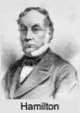
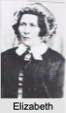
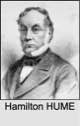
Hamilton Hume (1797-1873), explorer, was born on 19 June 1797, near Parramatta, New South Wales, the eldest son of Andrew Hamilton Hume and his wife Elizabeth, née Kennedy. An accomplished woman of an equable nature, Elizabeth was a perfect foil for her unpredictable husband, and gave her four children, particularly Hamilton, the rudiments of a sound education. In 1812 the family moved to a grant of 100 acres (40 ha) at Appin. Two years later Hamilton, 17, made his first journey of exploration when, with his brother John and an Aboriginal boy, he reached the Berrima-Bong Bong district. In the next two years Hamilton, leaving the youthful John at home, made two more successful journeys to the same district and penetrated as far as the Bungonia district.
At the request of Governor Macquarie, Hume in 1818 accompanied Charles Throsby and James Meehan to the 'New Country', virtually the area already referred to but taking in more of the County of Argyle. The party split up; Hume and Meehan pressed on and discovered Lake Bathurst and the Goulburn plains. Whilst at the lake Meehan discovered and traced the course of the Mulwaree River for some distance while Hume made an excursion to the Gourock range. Rejoining for the return journey they passed close to the site of what became Goulburn. Next year Hume accompanied John Oxley and Meehan to Jervis Bay; Hume and Meehan, who worked well together, returned overland. Throsby and John Macarthur next sought Hume's services as guide to the Bong Bong district, and in 1821 or 1822 Hume, accompanied by his brother-in-law, George Barber, and W. H. Broughton, discovered the Yass Plains: the party had gone to the Gunning district to establish a station. In 1822 Lieutenant Johnston, Alexander Berry and Hume reached the Clyde River; penetrating its upper reaches Berry and Hume moved inland almost to the site of Braidwood. For these services he received a grant of 300 acres (121 ha) at Appin and there built his first home. It was Berry who brought together Hume and Captain William Hovell for what was to be Hume's most famous and fruitful journey to Port Phillip and back in 1824-25. Hume agreed to lead a party overland to Spencer Gulf, but was unable to finance the journey wholly himself. As government backing was not forthcoming he was on the point of abandoning the project when Hovell offered to accompany him and share the cost. Hovell, an English sea captain, eleven years older than Hume, had settled on a grant at Narellan. He had little experience in the bush but could navigate. An agreement was signed but the arrangements were loose and unsatisfactory. The government contributed a few bare essentials: a tent, tarpaulin, pack-saddles, firearms and ammunition, but everything else was provided equally by the two principals, and each brought three assigned servants. Such instructions as the government's contribution permitted it to give were a bone of contention between Hume and Hovell almost from the start, and by mutual consent their objective was changed to Westernport. On 17 October 1824, a fortnight after leaving Hume's home at Appin, the party left his station at Gunning, then the farthest out. In the next sixteen weeks the party made many important discoveries including the Murray River, which the explorers for different reasons named the Hume, many of its tributaries, and the valuable agricultural and grazing lands between Gunning and Corio Bay in Victoria. It was a rich return for the distance travelled. They arrived back at Gunning on 18 January 1825. For his services Hume received a grant of 1200 acres (486 ha), which he was forced to sell to pay outstanding expenses; he had had to sell 'a fine iron plough' to pay for essentials before setting out. Both Hume and Hovell convinced Governors Sir Thomas Brisbane and (Sir) Ralph Darling that the farthest point reached by the expedition had been Westernport. Hume's failure to voice his suspicions that the point reached was Corio Bay in Port Phillip was a grave error. On the evidence available his later statement that he was 'aware of it all the time', must be considered an afterthought. Soon after his return Hamilton Hume married Elizabeth, second daughter of John and Hannah Dight of Richmond. The government in 1827 offered a grant or other indulgences for the discovery of a new road over the Blue Mountains. This attracted Hume and he was successful. Though his line of road was not adopted he received a grant of 1280 acres (518 ha) for his services and as additional remuneration for his work with Hovell. In 1828 he was attached by Darling to Charles Sturt's expedition into the interior. The party reached the Darling River. On this trip Hume showed his ability to work well and enthusiastically under a man he liked and respected. They became lifelong friends and Hume's ability to handle the Aboriginals was never better illustrated than on this journey. The appreciative Sturt endeavoured to obtain his services for an expedition down the Murray, but he was unable to go; Hume's health had been impaired by the rigours of the journeys with Hovell and he now had to consider his wife and his future. His choice of the Yass plains as the site of a home was probably made in the early 1820s when the area was already being settled by squatters. Hume moved to the plains in 1829, receiving one grant of 1280 acres (518 ha) and another of 1920 (777 ha). By 1830 he was established with several flocks of sheep and a number of pigs. Later he held three expanded holdings, Humewood, Marchmont and Eurolie. In 1839 he bought from Henry and Cornelius O'Brien a cottage and 100 acres (40 ha) on the Yass River and lived there. A few years later Hamilton Hume, who was childless, practically commandeered the eldest son of his youngest brother, Francis Rawdon Hume. The nephew largely took over the management of the holdings, and worked amicably with his uncle for two decades, laying the foundations of a merino stud that was not dispersed until 1914. In 1853 Hovell visited Geelong where he was fêted as its discoverer. Reports of this reached Hume, who was so incensed by what he considered a playing down of his part in the 1824 journey that he rushed into print. The result, a pamphlet entitled A Brief Statement of Facts in Connection with an Overland Expedition from Lake George to Port Phillip in 1824 (Sydney, 1855), gave Hume's version of the events that took place on the journey and the part played by Hovell. Evidence in support of Hume was given by three assigned servants, Angel, Fitzpatrick and Boyd, the last, for the journey, a servant of Hovell. It was a damning indictment and could not fail to injure Hovell in the eyes of the public. He retaliated with a Reply to 'A Brief Statement of Facts …' (Sydney, 1855) and thereafter remained silent. It was an unhappy, pointless quarrel which destroyed any friendship between Hume and Hovell that the success of the journey may have engendered. In 1860 Hamilton Hume was elected a fellow of the Royal Geographical Society. He became a magistrate and attended to his duties in Yass almost to the day of his death. An Anglican, he was a foundation trustee of St Clement's, Yass, and other institutions in the township. As the years advanced his health declined; another pointless quarrel resulted in the parting of uncle and nephew in 1865. From then on the explorer's deterioration was rapid. Almost totally deaf, with a failing memory, and now obsessed with the idea that his place in the 1824 expedition had not been restored in the public's estimation, he was preparing a second edition of his Statement when he died at his home, Cooma Cottage, Yass, on 19 April 1873. The third edition with addenda, published posthumously in 1874, added nothing to what was already known and only served to fan the embers of a bitter controversy. Hume's work as an explorer was done by the time he was 31, but it was very important. Despite his background he had to contend with the contempt of authority for the colonial-born. Such recognition and remuneration as he received stemmed entirely from his own energy, resource, and from the determination that brought the 1824 journey to a successful conclusion. By nature he was generous and genuinely fond of his many nephews and nieces, most of whom benefited from his will. Hamilton Hume and his wife, who survived him by thirteen years, were buried side by side at Yass cemetery. Portraits of both are at the Mitchell Library, Sydney. Australian Dictionary of Biography Hamilton Hume (1797-1873), explorer, was born on 19 June 1797, near Parramatta, New South Wales, the eldest son of Andrew Hamilton Hume and his wife Elizabeth, née Kennedy. An accomplished woman of an equable nature, Elizabeth was a perfect foil for her unpredictable husband, and gave her four children, particularly Hamilton, the rudiments of a sound education. In 1812 the family moved to a grant of 100 acres (40 ha) at Appin. Two years later Hamilton, 17, made his first journey of exploration when, with his brother John and an Aboriginal man, he reached the Berrima-Bong Bong district. In the next two years Hamilton, leaving the youthful John at home, made two more successful journeys to the same district and penetrated as far as the Bungonia district. At the request of Governor Macquarie, Hume in 1818 accompanied Charles Throsby and James Meehan to the 'New Country', virtually the area already referred to but taking in more of the County of Argyle. The party split up; Hume and Meehan pressed on and reached Lake Bathurst and the Goulburn plains. Whilst at the lake Meehan traced the traced the course of the Mulwaree River for some distance while Hume made an excursion to the Gourock range. Rejoining for the return journey they passed close to the site of what became Goulburn. Next year Hume accompanied John Oxley and Meehan to Jervis Bay; Hume and Meehan, who worked well together, returned overland. Throsby and John Macarthur next sought Hume's services as guide to the Bong Bong district, and in 1821 or 1822 Hume, accompanied by his brother-in-law, George Barber, and W. H. Broughton, found the Yass Plains: the party had gone to the Gunning district to establish a station. In 1822 Lieutenant Johnston, Alexander Berry and Hume reached the Clyde River; penetrating its upper reaches Berry and Hume moved inland almost to the site of Braidwood. For these services he received a grant of 300 acres (121 ha) at Appin and there built his first home. It was Berry who brought together Hume and Captain William Hovell for what was to be Hume's most famous and fruitful journey to Port Phillip and back in 1824-25. Hume agreed to lead a party overland to Spencer Gulf, but was unable to finance the journey wholly himself. As government backing was not forthcoming he was on the point of abandoning the project when Hovell offered to accompany him and share the cost. Hovell, an English sea captain, eleven years older than Hume, had settled on a grant at Narellan. He had little experience in the bush but could navigate. An agreement was signed but the arrangements were loose and unsatisfactory. The government contributed a few bare essentials: a tent, tarpaulin, pack-saddles, firearms and ammunition, but everything else was provided equally by the two principals, and each brought three assigned servants. Such instructions as the government's contribution permitted it to give were a bone of contention between Hume and Hovell almost from the start, and by mutual consent their objective was changed to Westernport. On 17 October 1824, a fortnight after leaving Hume's home at Appin, the party left his station at Gunning, then the farthest out. In the next sixteen weeks the party passed by many important locations not previously seen by Europeans, including the Murray River, which the explorers for different reasons named the Hume, many of its tributaries, and the valuable agricultural and grazing lands between Gunning and Corio Bay in Victoria. It was a rich return for the distance travelled. They arrived back at Gunning on 18 January 1825. For his services Hume received a grant of 1200 acres (486 ha), which he was forced to sell to pay outstanding expenses; he had had to sell 'a fine iron plough' to pay for essentials before setting out. Both Hume and Hovell convinced Governors Sir Thomas Brisbane and (Sir) Ralph Darling that the farthest point reached by the expedition had been Westernport. Hume's failure to voice his suspicions that the point reached was Corio Bay in Port Phillip was a grave error. On the evidence available his later statement that he was 'aware of it all the time', must be considered an afterthought. Soon after his return Hamilton Hume married Elizabeth, second daughter of John and Hannah Dight of Richmond. The government in 1827 offered a grant or other indulgences for anyone finding the route of a new road over the Blue Mountains. This attracted Hume and he was successful. Though his line of road was not adopted he received a grant of 1280 acres (518 ha) for his services and as additional remuneration for his work with Hovell. In 1828 he was attached by Darling to Charles Sturt's expedition into the interior. The party reached the Darling River. On this trip Hume showed his ability to work well and enthusiastically under a man he liked and respected. They became lifelong friends and Hume's ability to to negotiate with Aboriginal people was never better illustrated than on this journey. The appreciative Sturt endeavoured to obtain his services for an expedition down the Murray, but he was unable to go; Hume's health had been impaired by the rigours of the journeys with Hovell and he now had to consider his wife and his future. His choice of the Yass plains as the site of a home was probably made in the early 1820s when the area was already being settled by squatters. Hume moved to the plains in 1829, receiving one grant of 1280 acres (518 ha) and another of 1920 (777 ha). By 1830 he was established with several flocks of sheep and a number of pigs. Later he held three expanded holdings, Humewood, Marchmont and Eurolie. In 1839 he bought from Henry and Cornelius O'Brien a cottage and 100 acres (40 ha) on the Yass River and lived there. A few years later Hamilton Hume, who was childless, practically commandeered the eldest son of his youngest brother, Francis Rawdon Hume. The nephew largely took over the management of the holdings, and worked amicably with his uncle for two decades, laying the foundations of a merino stud that was not dispersed until 1914. In 1853 Hovell visited Geelong where he was fêted as its European discoverer. Reports of this reached Hume, who was so incensed by what he considered a playing down of his part in the 1824 journey that he rushed into print. The result, a pamphlet entitled A Brief Statement of Facts in Connection with an Overland Expedition from Lake George to Port Phillip in 1824 (Sydney, 1855), gave Hume's version of the events that took place on the journey and the part played by Hovell. Evidence in support of Hume was given by three assigned servants, Angel, Fitzpatrick and Boyd, the last, for the journey, a servant of Hovell. It was a damning indictment and could not fail to injure Hovell in the eyes of the public. He retaliated with a Reply to 'A Brief Statement of Facts …' (Sydney, 1855) and thereafter remained silent. It was an unhappy, pointless quarrel which destroyed any friendship between Hume and Hovell that the success of the journey may have engendered. In 1860 Hamilton Hume was elected a fellow of the Royal Geographical Society. He became a magistrate and attended to his duties in Yass almost to the day of his death. An Anglican, he was a foundation trustee of St Clement's, Yass, and other institutions in the township. As the years advanced his health declined; another pointless quarrel resulted in the parting of uncle and nephew in 1865. From then on the explorer's deterioration was rapid. Almost totally deaf, with a failing memory, and now obsessed with the idea that his place in the 1824 expedition had not been restored in the public's estimation, he was preparing a second edition of his Statement when he died at his home, Cooma Cottage, Yass, on 19 April 1873. The third edition with addenda, published posthumously in 1874, added nothing to what was already known and only served to fan the embers of a bitter controversy. Hume's work as an explorer was done by the time he was 31, but it was very important. Despite his background he had to contend with the contempt of authority for the colonial-born. Such recognition and remuneration as he received stemmed entirely from his own energy, resource, and from the determination that brought the 1824 journey to a successful conclusion. By nature he was generous and genuinely fond of his many nephews and nieces, most of whom benefited from his will. Hamilton Hume and his wife, who survived him by thirteen years, were buried side by side at Yass cemetery. Portraits of both are at the Mitchell Library, Sydney. The main highway between Sydney and Melbourne commemorates his contribution to Australian exploration, as do the Hume Dam and Lake Hume, on the upper reaches of the River Murray. |
| Source References: |
| 6. Type: Book, Abbr: Queanbeyan Register, Title: Biographical register of Canberra and Queanbeyan: from the district to the Australian Capital Territory 1820-1930, Auth: Peter Proctor, Publ: The Heraldry & Genealogical Society of Canberra, Date: 2001 |
| - Reference = 152 (Name, Notes) |
| 18. Type: E-mail Message, Abbr: e-mails general pool, Title: e-mails general pool |
| - Reference = Warren Sharpe 30 May 2104 (Birth) |
| - Reference = Warren Sharpe 30 May 2104 (Death) |
| - Reference = Warren Sharpe 30 May 2104 (Name, Notes) |