| [Index] |
| John PALMER (1760 - 1833) |
| Purser HMS Sirius, Commissiary General of the Colony 179- |
| Children | Self + Spouses | Parents | Grandparents | Greatgrandparents |
|
George Thomas PALMER (1784 - 1854) John Westwick PALMER (1786 - 1787) Henry Westwick PALMER (1787 - 1788) John PALMER (1797 - 1839) Edmund PALMER (1800 - 1800) Edwin Campbell PALMER (1801 - 1802) Sophia Susannah PALMER (1803 - 1856) |
John PALMER (1760 - 1833) + Susan STILWELL (1762 - 1832) |
John PALMER (1727 - 1808) | ||
| Sarah TAYLOR (1735 - 1796) | ||||


|
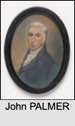


|
| b. 17 Jun 1760 at Portsmouth, Hampshire, England |
| m. 1783 Susan STILWELL (1762 - 1832) at Nova Scotia, Canada |
| d. 27 Sep 1833 at Parramatta, New South Wales, Australia aged 73 |
| Near Relatives of John PALMER (1760 - 1833) | ||||||
| Relationship | Person | Born | Birth Place | Died | Death Place | Age |
| Father in Law | Daniel STILWELL | |||||
| Mother in Law | Adriana WALTON | |||||
| Father | John PALMER | 1727 | 1808 | 81 | ||
| Mother | Sarah TAYLOR | abt 1735 | abt 1796 | 61 | ||
| Self | John PALMER | 17 Jun 1760 | Portsmouth, Hampshire, England | 27 Sep 1833 | Parramatta, New South Wales, Australia | 73 |
| Wife | Susan STILWELL | 06 Aug 1762 | Staten Island, Richmond, New York, USA | 22 Nov 1832 | Parramatta, New South Wales, Australia | 70 |
| Son | George Thomas PALMER | 26 Apr 1784 | Brompton, Kent, England | 26 Oct 1854 | Bath, Somerset, England | 70 |
| Son | John Westwick PALMER | 1786 | Brompton, Kent, England | 1787 | 1 | |
| Son | Henry Westwick PALMER | 1787 | Brompton, Kent, England | 1788 | Brompton, Kent, England | 1 |
| Son | John PALMER | 1797 | Brompton, Kent, England | 1839 | 42 | |
| Son | Edmund PALMER | 1800 | Cape of Good Hope, South Africa | 1800 | 0 | |
| Son | Edwin Campbell PALMER | 1801 | Woolloomooloo, New South Wales, Australia | 1802 | 1 | |
| Daughter | Sophia Susannah PALMER | 1803 | Woolloomooloo, New South Wales, Australia | 1856 | 53 | |
| Sister | Sophia PALMER | 1777 | Portsmouth, Hampshire, England | 05 May 1833 | Sydney, New South Wales, Australia | 56 |
| Daughter in Law | Catherine Irena PEMBERTON | 1787 | 04 Oct 1855 | Bath, Somerset, England | 68 | |
| Son in Law | Edward Charles Collinson CLOSE | 12 Mar 1790 | Rangamati, Bengal, India | 1866 | 76 | |
| Grandson | George Thomas PALMER | 06 Mar 1809 | Somerset, England | 14 Feb 1889 | Argyle, New South Wales, Australia | 79 |
| Grandson | William Pemberton PALMER | 11 Oct 1810 | Sydney, New South Wales, Australia | 19 May 1864 | Warialda, New South Wales, Australia | 53 |
| Grandson | John Macquarie PALMER | 1814 | Windsor, New South Wales, Australia | |||
| Granddaughter | Catherine Irena PALMER | 1816 | Windsor, New South Wales, Australia | 28 Apr 1863 | Bayswater, London, Middlesex, England | 47 |
| Granddaughter | Ingram Rider PALMER | 1818 | 1824 | 6 | ||
| Grandson | Henry Edmund Mitchell PALMER | 1821 | India | |||
| Grandson | Rodber Wylde PALMER | 1823 | Parramatta, New South Wales, Australia | 1887 | Albury, New South Wales, Australia | 64 |
| Granddaughter | Susan Adrianna 'Addie' PALMER | 1825 | Parramatta, New South Wales, Australia | 25 Nov 1902 | Goulburn, New South Wales, Australia | 77 |
| Grandson | Pemberton Campbell PALMER | 1827 | Sydney, New South Wales, Australia | 15 Aug 1885 | Queanbeyan, New South Wales, Australia | 58 |
| Grandson | Edward Charles CLOSE | |||||
| Granddaughter | Marrianne Collinson CLOSE | 1827 | Morpeth, New South Wales, Australia | 02 May 1903 | Duntroon, ACT, Australia | 76 |
| Grandson | Robert Campbell CLOSE | 1831 | New South Wales, Australia | |||
| Grandson | George Thomas Palmer CLOSE | 1834 | New South Wales, Australia | |||
| Nephew | John CAMPBELL | 1802 | Sydney, New South Wales, Australia | 1886 | Petersham, New South Wales, Australia | 84 |
| Nephew | Robert CAMPBELL | 05 Oct 1804 | Sydney, New South Wales, Australia | 1859 | Queanbeyan, New South Wales, Australia | 55 |
| Niece | Sophia Palmer CAMPBELL | 1807 | New South Wales, Australia | abt 1811 | England | 4 |
| Nephew | Charles CAMPBELL | 20 Sep 1810 | At sea | 17 Aug 1888 | Inverness, Inverness-shire, Scotland | 77 |
| Niece | Sophia Ives CAMPBELL | 1812 | Sydney, New South Wales, Australia | |||
| Niece | Sarah CAMPBELL | 1815 | Sydney, New South Wales, Australia | 28 Mar 1856 | Madeira, Atlantic Ocean | 41 |
| Nephew | George Palmer CAMPBELL | 27 Jun 1818 | Sydney, New South Wales, Australia | 25 Oct 1881 | London, Middlesex, England | 63 |
| Nephew | Frederick Marsden CAMPBELL | 1821 | Sydney, New South Wales, Australia | 1844 | 23 | |
| Brother in Law | Robert CAMPBELL | 28 Apr 1769 | Greenock, Renfrew, Scotland | 15 Apr 1846 | Duntroon, ACT, Australia | 76 |
| Events in John PALMER (1760 - 1833)'s life | |||||
| Date | Age | Event | Place | Notes | Src |
| 17 Jun 1760 | John PALMER was born | Portsmouth, Hampshire, England | 6 | ||
| 1783 | 23 | Married Susan STILWELL (aged 21) | Nova Scotia, Canada | 6 | |
| 26 Apr 1784 | 23 | Birth of son George Thomas PALMER | Brompton, Kent, England | 6 | |
| 1786 | 26 | Birth of son John Westwick PALMER | Brompton, Kent, England | 6 | |
| 1787 | 27 | Birth of son Henry Westwick PALMER | Brompton, Kent, England | 6 | |
| 1787 | 27 | Death of son John Westwick PALMER (aged 1) | |||
| 1788 | 28 | Death of son Henry Westwick PALMER (aged 1) | Brompton, Kent, England | 6 | |
| 26 Jan 1788 | 27 | Immigration | Sydney, New South Wales, Australia | per "Sirius" as perser | 6 |
| abt 1796 | 36 | Death of mother Sarah TAYLOR (aged 61) | |||
| 1797 | 37 | Birth of son John PALMER | Brompton, Kent, England | 6 | |
| 1800 | 40 | Birth of son Edmund PALMER | Cape of Good Hope, South Africa | 6 | |
| 1800 | 40 | Death of son Edmund PALMER | 6 | ||
| 1800 | 40 | Immigration | Sydney, New South Wales, Australia | per "Porpoise" | 6 |
| 1801 | 41 | Birth of son Edwin Campbell PALMER | Woolloomooloo, New South Wales, Australia | 6 | |
| 1802 | 42 | Death of son Edwin Campbell PALMER (aged 1) | 6 | ||
| 1803 | 43 | Birth of daughter Sophia Susannah PALMER | Woolloomooloo, New South Wales, Australia | ||
| 1808 | 48 | Death of father John PALMER (aged 81) | |||
| 22 Nov 1832 | 72 | Death of wife Susan STILWELL (aged 70) | Parramatta, New South Wales, Australia | 6 | |
| 27 Sep 1833 | 73 | John PALMER died | Parramatta, New South Wales, Australia | 6 | |
| Personal Notes: |
|
http://www.adb.online.anu.edu.au/biogs/A020276b.htm
PALMER, JOHN (1760-1833), commissary, was born in England. He entered the navy as a captain's servant at 9, and appears to have been educated entirely in the navy, which maintained schoolmasters for such recruits. During the American war of independence he was serving in H.M.S. Richmond which was captured off Chesapeake Bay by a French squadron on 11 September 1781. In 1783, after his release as a prisoner of war, the dark, handsome officer married Susan Stilwell (1761-1832), daughter of an American loyalist family. Palmer arrived in New South Wales with the First Fleet in 1788 as purser of Governor Arthur Phillip's flagship Sirius. The first Commissary, Andrew Miller, resigned in 1790 on account of ill health, and when the Sirius was wrecked off Norfolk Island Palmer was appointed commissary on 2 June 1791. In this post he was responsible for the reception and issue of all government stores, virtually the only supplies in the colony, and their supplement by purchase from private merchants. He negotiated payment for official business and was empowered to draw bills on the British Treasury. In effect he kept the public accounts and funds of the colony and was at once official supplier, contractor and banker to the settlement. The power and responsibility inherent in this office were wielded so discreetly and efficiently that Palmer enjoyed both official and private confidence. Though the Duke of Wellington observed in 1810 that 'the prejudice of society against a commissary almost prevented him from receiving the common respect due to the character of a gentleman' Palmer, perhaps because of his naval background and the rather indirect way in which he had succeeded to this office, always carried the 'character of a gentleman' in the colony. His convivial nature and engaging personality combined with refinement and discretion to commend him to most of those with whom he came in contact. By 1793 Palmer had decided to settle in New South Wales, though he had to wait three years before his application for leave was granted. In September 1796 he left for England in the Britannia, returning in November 1800 in the Porpoise with his wife and children, two sisters, Sophia (1777-1833) and Sarah (b.1774), and a naval brother, Christopher (1767-1821). In February 1793 Lieutenant-Governor Francis Grose had granted Palmer 100 acres (40 ha) at the head of Garden Island Cove, then known as Palmer's Cove. Here, set in an extensive orchard, Palmer built Woolloomooloo Farm, one of the colony's first permanent residences, where the Palmers lived and elegantly entertained the first rank of colonial society. 'Little Jack' Palmer was one of the most enterprising of the early settlers and acquired much knowledge of all aspects of the colony through his private speculations. Active and adventurous, he had early explored the interior of the colony, most of which he believed capable of cultivation. In 1795 Captain Henry Waterhouse described him as one of the three principal farmers and stockholders in the colony and in 1803 Palmer was hailed as the first exponent of improved farming methods when he reduced the men employed on his 300-acre (121 ha) Hawkesbury farm from a hundred to fifteen. When giving evidence before the select committee on transportation in 1812 Palmer claimed, 'I had more ground than anybody else; I farmed more than any other person did'. By 1803 he owned several small colonial-built craft. Two, the George and the John, were employed sealing in Bass Strait and another, the Edwin, plied up the Hawkesbury River and along the coast with grain, timber and coals. In 1803 one of his employees discovered a new coal-mine at Hunter's River. On 17 September 1801 Palmer's sister Sophia had married Robert Campbell, and during Campbell's absence in England in 1805 and 1806 Palmer acted as his agent. Palmer also owned a windmill on the margin of the Domain and a bakery near the present Conservatorium of Music. It is claimed that during the disastrous floods of 1806, when scarcity of grain inflated flour prices, Palmer ordered bread to be sold to the needy at lower prices than were then common. In his judicial capacity as a magistrate, which he had been appointed by Grose in 1793, and as one of the principal civil officers, Palmer was familiar with most of the disturbances that occurred in the colony. In later evidence he revealed that he was no friend of John Macarthur or of most of the New South Wales Corps. He had been Dr William Balmain's official second in 1794 when Macarthur had used the officers of the corps to insult the surgeon and avoid Balmain's challenge to a duel. When opposition to Governor William Bligh became evident, Palmer engaged himself in the governor's cause. As a result he too became the butt of rebel hostility. Palmer was one of those dining at Government House on the night of Bligh's deposition. In a letter he later wrote to Bligh, Palmer reported what had happened after the governor's arrest: 'Immediately after this transaction they surrounded my Office, and not only seized upon the whole of my Public and private Books and Papers but also ordered the Keys of the Stores to be given up, and I was told … to consider myself under an Arrest; they then put seals on the doors of the Office, and placed a Centinel at each door. A few days after Mr Bayley, Mr John Blaxland, and Mr Garnham Blaxcell broke the Seals of the Office, and ordered my Desk to be opened … they then seized my Ledgers, Books, and other Papers … I further beg leave to state that a Mr McArthur was appointed Colonial Secretary, a Situation never before known in the Colony, nor was ever permitted by Authority. Soon after he came to Act in that Situation he took from Major George Johnston three Government Ledgers, and had them removed to his House'. Although suspended by the rebels, Palmer embarrassed the new regime by persistently refusing, until instructed from England, to adjust claims made on the Commissary Department while he was in charge. He occupied himself in corresponding with Bligh about the alienation of government property, misappropriation of funds, and other malversations permitted under the rebel administration. After one of his demands for accounts was refused by Palmer, Macarthur accused him of insolence, contempt and disobedience and threatened that 'immediate measures will be resorted to, which, it is hoped, may bring you into a more temperate frame of mind'. In February 1809 Lieutenant-Colonel William Paterson refused Palmer permission to leave for England until he settled these accounts. On 18 March 1809 Palmer was committed by the rebel administration on a charge of sedition for having distributed, two days earlier, in company with Charles Hook, ex-Governor Bligh's proclamation, declaring New South Wales in a state of mutiny. Palmer denied the competency of the court and refused to plead, but was found guilty and sentenced to three months imprisonment in Sydney gaol and directed to pay a fine of £50. Palmer was reinstated by Governor Lachlan Macquarie but failed to receive any official consideration for deprivations suffered in the rebellion and, indeed, received barest justice at the hands of authority. Though the secretary of state instructed Macquarie to examine the commissariat accounts and see that the office was placed on a proper footing, he observed that as the complaints against Palmer 'have been chiefly brought forward since the arrest of Governor Bligh, it is probable they are exaggerated by Party'. Palmer's examiners at the Comptroller's Office in London held that the charges 'seemed to have arisen as much from private pique as from zeal for the public service' and were too vague to justify a formal inquiry; however, they thought it inexpedient to restore Palmer because of his long tenure in office, and recommended the appointment of another commissary. On 25 July 1811 Palmer was demoted to assistant commissary and placed on half-pay, and next year the entire commissariat system was reorganized. In 1810 Palmer had gone to England with Bligh as one of his chief witnesses against Johnston. During 1812 he gave valuable evidence to the select committee on transportation. In June 1813 he was re-employed in the commissariat and returned to New South Wales in May 1814. Soon afterwards a disagreement over the leasehold of five acres (2 ha) on which his windmill and bakery stood, which Macquarie claimed were in the Domain and which certainly overlooked Government House, resulted in the governor resuming them, albeit with compensation. In 1817 Macquarie recommended to London that Palmer be placed on half-pay, 'as he is of no sort of use whatever here nor never can be. He constantly resides at Parramatta, but does no duty there, and has had very little success in the recovering Payment of the Debts due to the Crown from individuals in this Country, for the recovery of which he was principally sent out'. In January 1819 Palmer was retired on half-pay. On his return to the colony in 1814 Palmer had found his private affairs extremely straitened. The estate of Woolloomooloo, mortgaged for over £13,000, was eventually sold to Edward Riley for £2290 in May 1822, though the stock and furnishings were auctioned in 1816. In January 1818 Palmer was granted 1500 acres (607 ha) at Bathurst, which he named Hambledon, but he ran only a handful of stock. In the 1820s the family fortunes recovered. Palmer received a grant in the Limestone Plains known as Jerrabombera, while at Waddon, near Parramatta, he farmed 3000 acres (1214 ha), one-third of which was cleared. By the 1830s he was running more than 3000 sheep and nearly 500 cattle. From August 1803 to January 1824 he had been a member of the committee of the Female Orphan Institution. As a magistrate he sat frequently on the bench at Parramatta until dismissed by Governor Sir Thomas Brisbane in the quarrel over the case of Henry Grattan Douglass in 1822; he was restored to the magistracy on 3 November 1825 and continued to sit until within a year or two of his death. His reputation for discreet benevolence was enhanced by a friendly manner and cheerful nature. He was an adherent of the Church of England. When he died at Waddon on 27 September 1833, he was 'the last surviving officer of the first fleet that arrived in this part of His Majesty's Dominions'. His wife died in September 1832; she was survived by three sons, George Thomas, John (1797-1839) and Edwin Campbell (b.1802), and a daughter, Sophia Susannah (b.1803), who had married Edward Close. Select Bibliography Historical Records of New South Wales, vols 2-7; Historical Records of Australia, series 1, vols 1-11; G. Mackaness, The Life of Vice-Admiral William Bligh (Syd, 1951); H. V. Evatt, Rum Rebellion (Syd, 1955); Sydney Gazette, 5 Mar, 10 Apr, 1, 8 May, 3 July, 21 Aug, 4 Dec 1803, 19, 26 Mar, 8, 15 Oct 1809, 13 July, 10 Aug 1816, 7 Apr 1821; WO 61/1, 2; Adm 1/5319, 36/10978. More on the resources Author: Margaret Steven Print Publication Details: Margaret Steven, 'Palmer, John (1760 - 1833)', Australian Dictionary of Biography, Volume 2, Melbourne University Press, 1967, pp 309-311. |
| Source References: |
| 6. Type: Book, Abbr: Queanbeyan Register, Title: Biographical register of Canberra and Queanbeyan: from the district to the Australian Capital Territory 1820-1930, Auth: Peter Proctor, Publ: The Heraldry & Genealogical Society of Canberra, Date: 2001 |
| - Reference = 249 (Marriage) |
| - Reference = 249 (Birth) |
| - Reference = 249 (Death) |
| - Reference = 249 (Immigration) |
| - Reference = 249 (Name, Notes) |