| [Index] |
| John PETER (1812 - 1878) |
| grazier (sheep), grazier (unspecified), JP, magistrate, mining investor, squatter, station manager |
| Children | Self + Spouses | Parents | Grandparents | Greatgrandparents |
| John PETER (1812 - 1878) + Mary BENT (1811 - 1884) |
||||
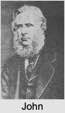
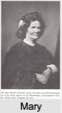
|
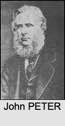
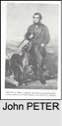
|
| b. abt 1812 at Glasgow, Lanarkshire, Scotland |
| m. 10 Feb 1837 Mary BENT (1811 - 1884) at Sutton Forest, New South Wales, Australia |
| d. 28 Jan 1878 at Torquay, Devon, England aged 66 |
| Near Relatives of John PETER (1812 - 1878) | ||||||
| Relationship | Person | Born | Birth Place | Died | Death Place | Age |
| Father in Law | John BENT | |||||
| Mother in Law | Frances WRIXON | |||||
| Self | John PETER | abt 1812 | Glasgow, Lanarkshire, Scotland | 28 Jan 1878 | Torquay, Devon, England | 66 |
| Wife | Mary BENT | abt 1811 | Jamisontown, Nepean River, New south Wales, Australia | 23 Sep 1884 | Broadmeadows, Victoria, Australia | 73 |
| Niece | Anne Frances BENT | 30 Oct 1850 | Narrandera, New South Wales, Australia | 30 Jan 1936 | Wagga Wagga, New South Wales, Australia | 85 |
| Nephew | John Beecher BENT | 29 Oct 1852 | Yanco, New South Wales, Australia | 06 Dec 1897 | Brighton, Victoria, Australia | 45 |
| Niece | Catherine Agnes BENT | 1856 | Yanco, New South Wales, Australia | 31 Aug 1940 | Holbrook, New South Wales, Australia | 84 |
| Niece | Rebecca Florence BENT | 27 May 1859 | Wagingoberemby, New South Wales, Australia | 07 Jul 1951 | Prahran, Victoria, Australia | 92 |
| Nephew | James Bernard Lowe BENT | 1862 | Boree Creek, New South Wales, Australia | 22 Jan 1940 | Wagga Wagga, New South Wales, Australia | 78 |
| Nephew | Bernard Low BENT | 27 Apr 1862 | Boree Creek, New South Wales, Australia | abt 1863 | 1 | |
| Niece | Alice Mary BENT | 29 Jan 1866 | Lake Albert, New South Wales, Australia | 25 Feb 1941 | Sydney, New South Wales, Australia | 75 |
| Sister in Law | Judith BENT | |||||
| Brother in Law | John Beecher BENT | 21 Sep 1821 | Campbelltown, New South Wales, Australia | 19 Feb 1880 | Broadmeadows, Victoria, Australia | 58 |
| Events in John PETER (1812 - 1878)'s life | |||||
| Date | Age | Event | Place | Notes | Src |
| abt 1812 | John PETER was born | Glasgow, Lanarkshire, Scotland | |||
| 10 Feb 1837 | 25 | Married Mary BENT (aged 26) | Sutton Forest, New South Wales, Australia | 71 | |
| 1848 | 36 | Residence | Gumly Gumly, New South Wales, Australia | 90 | |
| 28 Jan 1878 | 66 | John PETER died | Torquay, Devon, England | 62 | |
| Personal Notes: |
|
Gumly Gumly land claim Sydney Morning Herald 16 10 1848
134. Peter John. Name of run, Gumly Gumly. Estimated area, thirty thousand seven hundred and twenty acres. Estimated grazing capabilities, six thousand sheep. Gumly Gumly station commences at its eastern corner at the junction of Kyamba Creek with the Murrumbidgee, including the Kyamba Island, immediately opposite the junction of the said creek with the Murrumbidgee, where the river divides, running along the northern branch of the river so as to include the island and past its junction with the main stream five miles in a direct due west line (sinuosities not included) to a marked tree line boundary at Mr. Best's station, Wagga Wagga, which forms the western corner on the bank of the Murrumbidgee, from thence along this marked tree line for two miles running due south to the point of Best's range, from thence for one mile in a line south-west to two waterholes in the Stringybark Creek, one of which waterholes it includes from thence for one mile in a line south south-east to the Swampy Plain, from thence for half a mile in a line due west to the back of a creek called the Stringybark Spring Creek, following the Stringybark Spring Creek up to its head about four miles, passing the springs in which it takes its rise, to a gap in the range immediately above the springs ; from this point along the ridge of a leading range in a general south- east line for seven miles to a point joining its south corner, from thence along the top of a leading range running in a general north east line for ten miles, striking upon the Kyamba Creek about four miles above its junction with the Murrumbidgee, which creek it follows to its junction, where the eastern boundary corner commences as described above. Australian Dictionary of Biology https://adb.anu.edu.au/biography/peter-john-4392 John Peter (1812-1878), pastoralist, was born near Glasgow, Scotland, son of a prosperous farmer. His father offered a farm and flour-mill to dissuade him from migrating, but Peter was determined. At 20, with £50 for the return fare in his pocket, he sailed from Liverpool in the Mail, arriving at Sydney on 3 December 1832. Introduced to Alexander McLeay, Peter accepted his offer as manager of his station at £40 a year with 1 per cent on the value of the wool clip in the first year and an additional 1 per cent thereafter. Ten days later he found the station littered with the bones of sheep dead from scab and starvation. In 1836 a severe catarrh epidemic reduced the flocks of most local settlers but Peter lost only a fifth of his sheep by providing plentiful supplies of rock salt. He decided to move to the Murrumbidgee District where he knew salt bush was prolific. At Camden on 10 February 1837 Peter contracted an auspicious marriage with a widow, Mary Bourke, a native of Campbelltown. J. Gormly described Mrs Bourke as 'a capable station manager and one of the most active women among stock I have known'. Her first husband had left her the run, Gumly Gumly, for which Peter took out a licence in 1837 in addition to a ten-mile (16 km) frontage on the Murrumbidgee for himself. For twelve years he managed the Macleays' properties as well as his own. He increased the quantity and quality of their stock, sometimes surviving only on savings, through droughts, the depreciation of colonial produce in the early 1840s, labour shortages and a severe epidemic of Cumberland disease. When he left the Macleays', they gave him a thousand select ewes. In 1854 after the gold discoveries the value of fat sheep rose from 5s. to 30s. and cattle from 15s. to £8-£10. With his wife's help, Peter accumulated vast pastoral holdings in the Murrumbidgee and Lachlan Districts. In 1848 he was licensee of Cuba, Gumly Gumly, Ugoble and Sandy Creek; by 1859 he had 15 runs in 3 districts and by 1866 had 17 runs totalling over 740,000 acres (299,700 ha) including Bungerra, Banandra, Gumly Gumly and 9 runs comprising Tubbo estate. In the 1860s in Queensland J. Peter & Co. held Thalberg and Winterbourne in the Port Curtis District and with George Macleay, Arthur Onslow, Andrew Bonar and William Onslow held Carnarvon and Consuelo in the Leichhardt District. He also owned properties on the Culgoa River near Bourke and at Broadmeadows near Melbourne. Although he did little rough work he closely supervised the detailed running of his enormous transactions, keeping a light carriage and good horses, to travel quickly around the stations. Known as 'Big Peter', he was reputed to be one of the most progressive pastoralists in the Murrumbidgee area. Peter was active in local affairs and the growth of Wagga Wagga. He was influential in agitating for the establishment of a Court of Petty Sessions there in 1847 and became one of the most regular of the local magistrates. He was also treasurer of the board appointed to build the National school and contributed handsomely in funds and pupils from his outlying stations. As president of the 1856 committee which later provided a hospital, he also gave liberally to the Mechanics' Institute and the Presbyterian Church. In 1845 Peter bought three £5 shares in the South Australian Burra copper-mine which yielded fifteen dividends of 200 per cent each for the next five years. By the late 1850s he had become the wealthiest resident squatter in New South Wales. Retaining his colonial interests, he retired to Britain in the early 1860s. He took a house in Piccadilly and another in Suffolk, dividing his time between them and Glasgow with visits to Europe interspersed with splendid shooting parties in the Highlands for his friends. One of these, Roger Therry, found him markedly generous with 'shrewdness of judgement and a persevering spirit'. Childless, Peter provided liberally for his friends, family and the education of his nieces and nephews; his reputed income by 1866 was £40,000 a year. He died on 28 January 1878 at Torquay, leaving substantial legacies to his family and the charities with which he had been associated in Wagga Wagga. His goods were sworn at £65,000. His wife died on 23 September 1884 aged 73. Select Bibliography R. Therry, Reminiscences of Thirty Years' Residence in New South Wales and Victoria, 2nd ed (Lond, 1863) J. Gormly, Exploration and Settlement in Australia (Syd, 1921) R. B. Ronald, The Riverina: People and Properties (Melb, 1960) K. Swan, A History of Wagga Wagga (Wagga Wagga, 1970) J. J. Baylis, ‘The Murrumbidgee and Wagga Wagga’, JRAHS, 13 (1927) Sydney Herald, 3 Dec 1832 Australian, 17 July 1838, supplement Town and Country Journal, 6 Apr 1878 D. Denholm, Some Aspects of Squatting in New South Wales and Queensland, 1847-1864 (Ph.D. thesis, Australian National University, 1972) Macarthur papers (State Library of New South Wales). |
| Source References: |
| 62. Type: Web Page, Abbr: Australian Dictionary of Biography, Title: Australian Dictionary of Biography Online Edition, Publ: ANU, Locn: http://www.adb.online.anu.edu.au/adbonline.htm |
| - Reference = https://adb.anu.edu.au/biography/peter-john-4392 (Death) |
| 71. Type: Book, Abbr: Wagga Pioneers, Title: Pioneers of Wagga Wagga and District, Auth: Wagga Wagga & District Family History Society Inc, Publ: Wagga Wagga & District Family History Society Inc, Date: 2004, Locn: http://www.waggafamilyhistory.org.au/ |
| - Reference = 27 (Marriage) |
| - Reference = 27 (Name, Notes) |
| 90. Type: Book, Abbr: History of Wagga, Title: A History of Wagga Wagga, Auth: Keith Swan, Date: 1970 |
| - Reference = p30 (Residence) |
| - Notes: licence-holder of Gumly Gumly run in 1848 and was living there at the latest by 1849 when G. W. Rusden, agent for Board of National Education, spent several nights as his guest. |
| - Reference = facing page 24, p67 (Name, Notes) |
| - Notes: page 67 Establishing a hospital. Those enterprising townsmen George Forsyth and F. A. Tompson were treasurer and secretary respectively, and John Peter, J.P., was elected President. Peter was a most influential pastoralist who was vitally associated with the development of village and district. A Scot, he came to New South Wales during the 1830s, worked as a station superintendent for the well known Macleay family which occupied several pastoral runs on the Murrumbidgee from east of Wagga Wagga to Hay and is said to have been given a flock of sheep as payment during the economic depression of the 1840s. He came to the vicinity of Wagga Wagga and married a widow, Mrs Bourke, the occupier of Gumly Gumly Station, in 1837. When the first descriptions of pastoral runs were published in the New South Wales Government Gazette in 1848, Peter was the occupier of almost twenty runs in the Murrumbidgee and Lachlan Pastoral Districts, and for the next twenty years until his retirement to the United Kingdom in 1871 he was one of the most successful pastoralists of the colonies. He was said to have offered his stations to James Tyson for £1,000,000 sterling on the eve of his retirement.
John Peter was one of the signatories to the 1847 letter requesting that a court of petty sessions be established in Wagga Wagga; he was the justice of the peace who sat most frequently on the Wagga Wagga Bench; and when G. W. Rusden visited Wagga Wagga in August 1849 to investigate the establishment of a National School it was Peter who afforded him tremendous assistance and advice. Tradition has Peter a rather ruthless pastoralist, but he was active in the establishment of the village, giving liberally to various causes like the Hospital, Churches, National School and Mechanics' Institute, and serving on many committees such as this Hospital Committee. |